Reformat Component in ab initio with example and real time environment
 Purpose
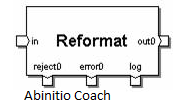
Reformat changes the format of records by dropping fields, or by using DML expressions to add fields, combine fields, or transform the data in the records.
Recommendation
Component folding can enhance the performance of this component. If this feature is enabled, the Co>Operating System folds this component by default. See “Component folding” for more information.
Location in the Component Organizer
Transform folder
Runtime behavior of REFORMAT
The component reads records from the in port.
If you specify an expression for the select parameter, the expression filters the records on the in port:
- If the expression evaluates to 0 for a particular record, Reformat does not process the record, which means that the record does not appear on any output port.
- If the expression produces NULL for any record, Reformat writes a descriptive error message and stops execution of the graph.
- If the expression evaluates to anything other than 0 or NULL for a particular record, Reformat processes the record.
If you do not specify an expression for the select parameter, Reformat processes all the records on the in port.
If you specify a value for either output-index or output-indexes, Reformat passes the records to the transform functions, calling the transform function on each port in order, depending on the value of output-index or output-indexes, for each record, beginning with out port 0 and progressing through out portcount – 1.
The evaluation of the transform functions takes place within each partition of a Reformat running in parallel, which means that evaluations of later transform functions can depend on the results of the evaluations of earlier transform functions, such as modification of global variables or use of functions such as next_in_sequence.
If you do not specify a transform function for a particular out port, Reformat uses default record assignment. (For more information, see “Default record assignment”.) You can use default record assignment to eliminate fields from a record format.
Reformat writes the valid records to the out ports.